This page is part of the Court Officers Act 1926 exhibition.
Return to the exhibition
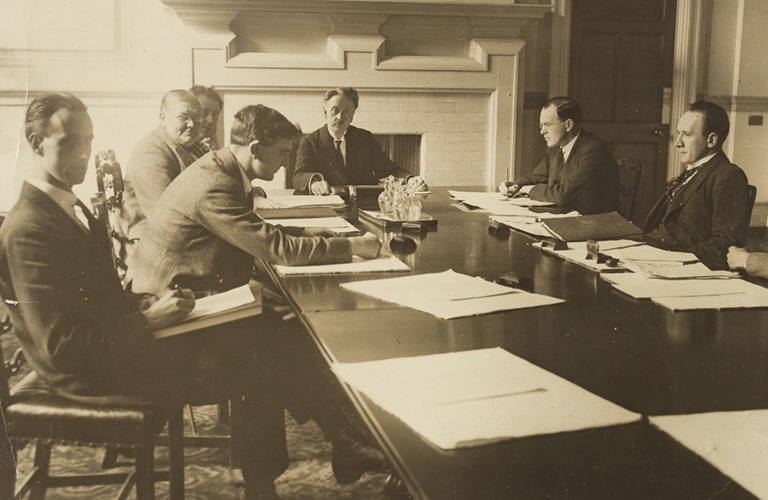
The setting up of a new courts system was one of the immediate priorities of the new Government following the establishment of the Irish Free State (Saorstát Éireann) – as indicated by W.T. Cosgrave, TD, President of the Executive Council, when introducing the Courts of Justice Bill 1923 in the Dáil:
“The Government consider it very important to have National Courts of Justice in existence at the earliest possible moment in order that the people may have the most complete confidence in the administration of the law, and may be thereby led to respect for the law which previously existing circumstances did not inspire.”
The enactment of the Court Officers Act 1926 was one of the final pieces of legislation required to support the new courts system created by the Courts of Justice Act 1924.
The Court Officers Bill 1926 sought to
- provide for the office structures and staffing needed to support the courts established in 1924 and
- integrate the courts administration fully into the Civil Service structure, placing court staffing and funding under the control of the Executive in a manner similar to that in other Government Departments.
In the process, judicial or political patronage in the appointment of court officers and staff would be removed, staff grading, salaries, conditions of service and tenure among staff within each jurisdiction would as far as possible be standardised and the transaction of court business would be rationalised. In the higher courts in particular, the complex patchwork of offices and chambers inherited from the British regime would be rationalised.
However, what at first sight may have seemed an uncontroversial reforming measure soon generated significant tension between the judicial and executive branches of the new Irish Free State. This took the form of a very public and ill-tempered dispute – avidly reported in the Press - between Chief Justice Hugh Kennedy as head of the Judiciary and Kevin O‘Higgins, who as Minister for Justice was the Minister charged with steering the Bill through its various stages in the Oireachtas.
The compromise reached in that dispute –incorporated in the 1926 Act – continues to be part of the legal framework underpinning the management and administration of the courts to this day.
Return to the Court Officers Act 1926 exhibition


