Court Officers Act 1926: A Century of Service
This year marks the centenary of the Court Officers Act 1926, legislation that helped shape the administration of the courts in Ireland.
For one hundred years, court officers have played an important role in supporting the delivery of justice and the day-to-day operation of courts across the country. Through photographs, documents and historical records, this exhibition highlights the people, traditions and developments that have shaped the role over the past century.
We invite you to explore this collection and learn more about the enduring contribution of court officers to Ireland's courts and justice system.
Panel 1: Supporting the Courts for a Century - The Court Officers Act 1926
With the enactment of the Court Officers Act 1926, one of the final building blocks in the structure of the new courts system created by the Courts of Justice Act 1924 was put in place. The Act provided, for the first time, a comprehensive statutory basis for the staffing, organisation and administration of all the courts.
The Act replaced complex and fragmented arrangements inherited from the British regime, under which court offices operated independently, appointments were often made by patronage, and conditions of service varied widely. It introduced a unified structure, integrated court officers into the Civil Service, and standardised recruitment, remuneration and promotion.
However, the Act’s passage was marked by a significant constitutional controversy concerning the roles of the judiciary and the executive in controlling the court administration. The resolution of that dispute—balancing judicial independence with ministerial responsibility—was an important feature of the Act.
A century later, many of the structures and principles contained in the Court Officers Act 1926 continue to underpin the administration of justice in Ireland.
Panel 2: Administering the Courts in Newly-Independent Ireland – the Challenges
By early 1926, the administration of the courts in the Irish Free State faced serious structural and practical difficulties. The system inherited from the British regime lacked central coordination and was characterised by inconsistent staffing arrangements, varying conditions of service and a continued reliance on patronage – judicial and political - particularly in senior appointments.
The departure of many experienced court officers following Independence created a significant loss of expertise. At the same time, public finances were under severe strain after the War of Independence and Civil War, limiting resources available for reform.
Physical infrastructure had also suffered extensive damage. The Four Courts, the central seat of justice, had been largely destroyed in 1922, and many courthouses nationwide required to be rebuilt or replaced.
The situation was complicated by the legacy of the Dáil Éireann courts. Many of the staff of those courts hoped for positions in the new courts established under the Courts of Justice Act 1924.
The Court Officers Act 1926 aimed to establish the administrative machinery necessary to support the new courts and to place staffing and funding under executive control, in line with other Government Departments. In doing so, it sought to replace outdated arrangements with a unified, professional Civil Service structure.
However, these reforms led to a significant and public dispute between the judiciary and the executive, the resolution of which has shaped the future administration of the courts.
Panel 3: The Pre-Independence Courts
Before independence, Ireland’s courts were governed by the Supreme Court of Judicature (Ireland) Act 1877, which unified the higher courts into a High Court of Justice and a Court of Appeal. The High Court operated in divisions and exercised both original and appellate jurisdiction.
Following the Government of Ireland Act 1920, separate systems were created for Northern and Southern Ireland, with an overarching appellate structure.
At local level, justice was administered by Justices of the Peace and Resident Magistrates, whose jurisdiction was primarily criminal and often exercised by individuals who were not legally qualified. In Dublin, similar functions were carried out by stipendiary magistrates.
Civil jurisdiction at local level – extending to a broad range of disputes but limited to £50 in respect of money claims – was exercised by county. More complex matters were handled in the higher courts in Dublin.
Panel 4: The New Courts System of 1924
The Courts of Justice Act 1924 established a new courts system for the Irish Free State, implementing the recommendations of the Judiciary Committee of 1923. That committee, chaired by Lord Glenavy - a former Lord Chief Justice and later Lord Chancellor of Ireland – had produced its report with impressive speed - in little more than four months - in May 1923.

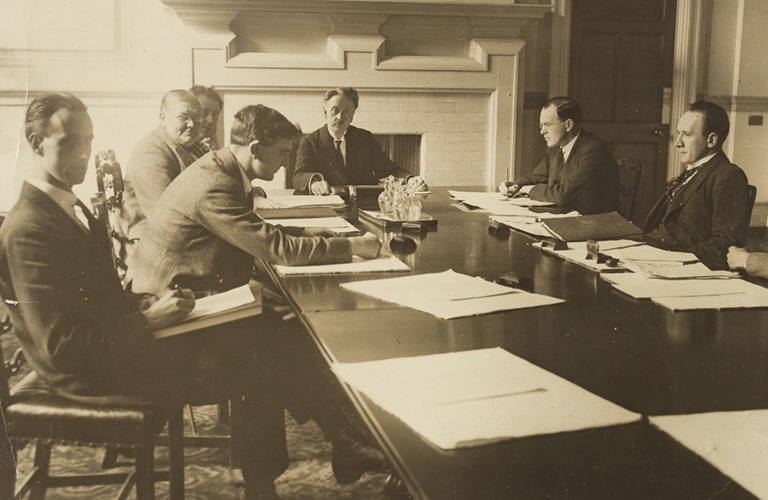
Judiciary Committee of 1923
(Lord Glenavy, Chairman, is seated on the extreme right. Hugh Kennedy, who took office as the first Attorney General of the Irish Free State in March 1923, having served as Law Officer of the Provisional Government, in seated at the centre)
The system consisted of -
- The District Court, with professional judges and limited civil and criminal jurisdiction
- The Circuit Court, with expanded civil jurisdiction, criminal jurisdiction in indictable cases, and jurisdiction to hear appeals from the District Court
- The High Court, with full original jurisdiction
- The Court of Criminal Appeal
- The Supreme Court as the final appellate court
Key innovations included -
- the replacement of lay magistrates with a fully professional judiciary at District Court level
- the redistribution of civil business to regional Circuit Courts and District Courts and
- the abolition of the grand jury’s role in criminal prosecutions.
The new system aimed to improve accessibility to justice, and introduce greater efficiency and coherence in the administration of justice.
However, while the courts themselves were established, the administrative structures required to support them were not included in the 1924 Act. This required further legislation, in the form of the Court Officers Act 1926.
Panel 5: The Courts Administration Prior to Independence - a pressing need for reform
Prior to 1926, court administration in Ireland was fragmented and inefficient. Offices in the higher courts operated as separate units with overlapping functions, requiring litigants to deal with multiple offices during the course of a single case.
Salaries and working conditions were inconsistent. Recruitment and promotion practices varied widely and were often influenced by patronage. Senior positions could be filled by relatives or associates of judges, and tenure could extend indefinitely.
“…any post worth £500 a year or over it, and sometimes even lesser posts, were filled when they became vacant by judicial patronage, and very often by the appointment of a son, nephew or close relative or friend of the judge in whom the power of appointment was vested… these are notoriously the facts with regard to the staffing of the High Court in the past.”
(Minister O’Higgins, speaking in Dáil Éireann on the Court Officers Bill 1926, 11th March 1926)
“He was a painstaking and courteous official and was a regular and unfailing attendant at his office until the Four Courts were seized and occupied by the forces of the I.R.A. some five or six weeks ago. He still enjoys good health, and is as active as a man of 90 years could expect to be …”.
(The Irish Law Times and Solicitors' Journal reporting on the retirement in 1922 of Hugh Doyle, the Chief Clerk in Bankruptcy, after 73 years of “unexampled service”. Mr Doyle had joined the courts in 1849, at the age of 17)
The Waterfield report of 1921 highlighted serious deficiencies, including excessive staffing, duplication of work, inadequate supervision, and poor working practices.
At local level, similar issues prevailed. Appointments of Clerks of the Crown and Peace and other officials were made through a complex system involving judicial and political patronage. Duties and conditions of service were often ill-defined, and remuneration varied.
Panel 6: Court Officers – Notable Lives (Bram Stoker)
Bram Stoker (1847 –1912), renowned author of the gothic novel “Dracula” (published in 1897), joined the Office of the Registrar of Petty Sessions in 1866, while continuing to pursue studies in Trinity College Dublin - taking an M.A. degree there and studying at the Law School, and then being called to the English Bar.
The Office of the Registrar of Petty Sessions, which was located in Dublin Castle, had oversight of the operation of the petty sessions courts nationwide and Stoker worked there for 13 years, for the last two of which he served as the first Inspector of Petty Sessions. Stoker’s manual, “The Duties of Clerks of Petty Sessions” – a standard authority on the subject – was published in Dublin in 1879, the year following his resignation from office.
Stoker resigned to assist the actor-manager, Henry Irving in managing the Lyceum Theatre in London.
“Many of his friends in Dublin thought at the time that it was hardly wise on his part to give up the certainty of a Government position, carrying with it a substantial pension, and to commence life afresh in the hazardous theatrical profession.”
( “Obituary – Mr. Bram Stoker”, Irish Times, 26th April, 1912)


Panel 7: Court Officers – Notable Lives (Eoin MacNeill)
Eoin MacNeill (1867–1945), a key figure in the foundation of Conradh na Gaeilge in 1893 and the Irish Volunteers in 1913, Eoin MacNeill joined the Accountant-General’s Office in the Supreme Court of Judicature in the Four Courts as a junior clerk in 1887, being the first clerk in the office to be appointed by competitive examination rather than patronage. While serving in the courts, he devoted himself to the study of the Irish language and to his duties as secretary of Conradh na Gaeilge – activity which was not looked on favourably by his superiors in the courts but which did not prevent his being promoted to First Class Clerk in that office in 1897. He left the service of the courts in 1909 to accept an appointment as foundation Professor of Early Irish History in UCD, forgoing his pension entitlements in consequence.

MacNeill was arrested in the aftermath of the Easter Rising and sentenced to life imprisonment, but was released under the general amnesty in 1917 and elected a Sinn Féin MP in the 1918 and 1921 general elections, becoming Ceann Comhairle of the second Dáil and presiding over the debates on the Treaty. He was Minister for Education in the Irish Free State Government from 1922 to 1925 and a nominee of that Government to the Boundary Commission. Failing to secure re-election in 1927, he returned to academic life, but continued to be active in the public sphere, including chairing the Irish Manuscripts. He retired from U.C.D. in 1941.
“I entered the Accountant General’s Office in 1887… The Accountant-General, the Chief Clerk, the senior clerks, and all the junior clerks but myself were appointed before the competition law came into effect...
”
(Extract from a letter from MacNeill to Jeremiah MacVeagh, Irish nationalist M.P.)
Panel 8: Court Officers – Notable Lives (Georgina Frost)
Georgina (‘Georgie’) Frost (1879–1939) was the first and only woman to hold office as a Petty Sessions Clerk – though only after challenging the prohibition on women holding that office in a celebrated case which proceeded as far as the House of Lords. As in most areas of the public service, women were effectively excluded from positions in the courts administration of the pre-Independence era – though not from the Dáil Éireann Courts, which had women judges and clerks - and court officerships after Independence remained largely the preserve of men until the 1940s.
She had acted as Petty Sessions Clerk for the district of Sixmilebridge and Newmarket-on-Fergus for more than five years prior to 1915 while her father, the Petty Sessions Clerk, was ill. On his retirement, the justices at petty sessions appointed her in his place but were informed that the Lord Lieutenant could not approve the appointment of a woman as Petty Sessions Clerk, and were directed to hold a new election. The justices then elected her as temporary Petty Sessions Clerk for a period of twelve months, to allow time for a court to decide whether she could hold the office.
Frost brought proceedings challenging the Lord Lieutenant’s refusal to approve her appointment, but lost in the High Court and in the Court of Appeal. Frost then appealed to the House of Lords.
.jpg?Status=Master&sfvrsn=85841bc3_1?sfvrsn=85841bc3_1)

By then the Sex Disqualification (Removal) Act 1919 – prohibiting disqualification from public office on grounds of sex or marriage - had become law and the appeal did not proceed. Frost was finally appointed Petty Sessions Clerk, but the abolition of that post and its replacement by the office of District Court Clerk brought her career to a premature end.
“…it is not alleged that any holder of any office corresponding to this office has ever been a woman. … I do not feel at liberty to break such thick ice; if it is to be done it must be by a superior court or by the legislature.”
(Barton J in Frost v The King, 1917)
Panel 9: The Court Officers Bill 1926
The Court Officers Bill 1926, introduced in the Dáil in on the 24th February 1926, provided for the establishment of a new administrative structure for the courts, implementing recommendations of the Judiciary Committee’s recommendations for a new office structure for the various court jurisdictions
- in the High Court and Supreme Court
- the Central Office, under the management of a new post of Master of the High Court, who also was to be given quasi-judicial powers
- the Taxing-Master’s Office
- the Probate Office
- the Bankruptcy Office (to include the Registrar’s branch, managed by the Registrar in Bankruptcy and the Official Assignee in Bankruptcy’s branch)
- the Examiner’s Office
- the Accountant’s Office
- the Office of the Registrar of the Supreme Court (who also acted as Registrar to the Court of Criminal Appeal)
- an Office of the Registrar to the Chief Justice (administering the jurisdiction of the Chief Justice in respect of wards of court and minors, solicitors’ matters and commissioners for oaths)
- interchangeability of staff (other than the principal officers) between the offices of the higher courts as and when directed by the Minister
- in the Circuit Court,
- a Circuit Court Office for every county and county borough, managed by the County Registrar – a new post
- The County Registrar’s functions included those previously exercised by the Clerk of the Crown and Peace and the registrar of a civil bill court, as well as any new powers and duties conferred by statute or rule of court.
- in the District Court,
- the post of District Court Clerk (created on an interim basis in 1923 but now made permanent)
Panel 10: Control of the New Courts Administration
The provisions in the Court Officers Bill concerning control of court administration quickly gave rise to a public controversy between the Judiciary and the Government.
The Government had proposed that appointments, transfers, and conditions of service of court officers should be subject to ministerial control. Opposition figures argued that this risked undermining the independence of the judiciary.
In a lengthy (34-page) letter to the Minister for Justice, Kevin O’Higgins, on the 15th March 1926, Chief Justice Hugh Kennedy, on behalf of the Supreme Court and High Court judges, expressed strong objections to the Bill. The Chief Justice supported the abolition of judicial patronage (“...I have consistently refrained from exercising it and I personally rejoice to be relieved of it”) but opposed the transfer of full control of court staff to the Executive, arguing that judicial control was essential to the proper administration of justice and to maintaining judicial independence. He also objected to the proposed ministerial powers over court fees and appointments of experts such as receivers, auctioneers and medical visitors who reported to the court in individual cases.
Not having received a response from the Minister, or to a letter of the 19th March Chief Justice Kennedy wrote to W.T. Cosgrave, President of the Executive Council, on the, concluding:
“…The matter affects the whole public interest, and if this Bill is to be pressed in its present form, the public of all parties should be made aware of its real nature.”
The Chief Justice then made the Judiciary’s concerns public at the annual Charter Dinner of the Royal College of Surgeons on the following evening.


Irish Independent report of Chief Justice Kennedy's speech, 22 March 1926
Panel 11: Control of the New Courts Administration
The Chief Justice’s position received support in the Press, from courts staff and from within the legal profession. The Irish Times’ legal correspondent considered that “the Chief Justice has raised the discussion on the Free State Court Officers Bill to a higher plane.” The Irish Independent reported on the reaction in the courts:
“Both Court officials and members of the Bar are opposed to some of the provisions in the Court Officers Bill, at present before the Dáil. The Bill, it, is held, whilst allowing some independence to the judges, at the same time handcuffs them in other ways.
Legal circles favour changes in the measure designed to retain internal control and to secure firmly the independence of the judiciary….”.
Irish Independent, 23rd March, 1926


Minister for Justice O’Higgins was unsympathetic to the criticisms of the Bill. Speaking in the Dáil on the 23rd March on the Estimates for his Department – which included provision for the salaries of courts staff – he affirmed the Government’s attachment to the principle of judicial independence, but asserted:
“… It is not a corollary to the independence of the Judiciary that the staffs in the public offices attached to the courts shall be lifted above the plane of Parliamentary criticism, shall be immune from comment or criticism in the Parliament of the people; that there shall be no Ministerial control and no responsibility to the electorate, through their representatives, in respect of that important branch of public administration…”.
But the Minister nonetheless signalled that the Government had taken heed of the Chief Justice’s concerns – announcing that he would be “bringing forward a good many amendments arising out of the views of the Judiciary with which I have been favoured by the Chief Justice.”
Panel 12: Resolving the Controversy
The dispute between the judiciary and the executive was resolved through amendments to the Bill. These amendments preserved ministerial responsibility for staffing and administration while ensuring that judicial independence was protected.
The final Act provided:
- Consultation with the Chief Justice and President of the High Court on staffing matters.
- Restoration of judicial roles in appointing experts and managing wardship matters.
Significantly, a new section was introduced – entitled “Preservation of judicial control of court business”, which became section 65 of the Bill as enacted, subsections (1) and (2) of which provided:
- "Nothing in this Act shall prejudice or affect the control of any judge or justice over the conduct of the business of his court.
- When an officer attached to any court is engaged on duties relating to business of that court which is for the time being required by law to be transacted by or before or under or pursuant to the order of a judge or judges of that court he shall observe and obey all directions given to him by such judge or judges.”
This last amendment was proposed by the Government “in order to remove any doubt that might exist as to the independence of the judges in judicial matters.”
Thus, a potentially damaging dispute between the Executive and Judicial Branches at the beginnings of the new State’s existence was resolved.
On the 21st May, 1926 – the day following passing of the Bill in the Dail and its referral to the Seanad – W.T. Cosgrave, President of the executive Council, wrote to Chief Justice Kennedy, apologising for failing to reply to the Chief Justice’s letter to him of the 19th March, and concluding with the words:
“I am glad the matters in question were subsequently adjusted satisfactorily”.
Panel 13: Aftermath of the 1926 Act
The Act’s implementation led to significant changes in staffing. Many officers left service, while others remained to play important roles in the new system. Among those who continued in service were –
- Gerald Horan, K.C. (1880–1949), formerly Clerk of the Crown and Hanaper and ex-officio Permanent Secretary to the Lord Chancellor. He participated in the 1921 Waterfield inquiry into court offices and became the first Master of the High Court under the 1926 Act.
- Constance P. (“Con”) Curran (1883–1972) began his career in 1903 in the Accountant-General’s Office. As Registrar of the High Court in 1922, he attempted to protect records during the destruction of the Four Courts. He later served as Registrar of the Supreme Court from 1946 to 1952.h James Joyce.


In the District Court, all District Court clerks outside Dublin and Cork (a little over 160) were fresh appointees, the majority of whom were associated with the Dáil Éireann Courts or the Independence movement. very few of the former Petty Sessions Clerks were re-employed.
Some new appointees had held senior positions with the pre-Treaty Dáil Éireann authorities.
- George Nicholls (Seoirse Mac Niocaill) (1887-1942) had been Assistant Minister in the Dáil Éireann Department of Home Affairs, having been a leading figure in Galway in the Irish Republican Brotherhood and in the Easter Rising of 1916. He served as a TD in Dail Éireann, becoming Parliamentary Secretary to the Minister for Defence between 1925 and 1927. Not having stood as a candidate in the General Election of June 1927, he served as County Registrar for Galway from 1928 until 1941.
- Pádraig Crump had served as Secretary to the Dáil Éireann Department of Home Affairs in 1922. Crump ascended to the Secretaryship of the Department and was secretary to the committee established to advise on arrangements to wind up the Dáil Éireann courts. He was appointed as an officer of the High Court in 1924 and was also designated an official interpreter for the Irish language in the court offices.
- T.V. Cleary had been registrar of the Dáil Éireann Supreme Court. He became Chief Clerk of the Dublin Metropolitan District Court.
Twenty-six county registrars replaced twenty-seven Clerks of the Crown and Peace. Of the twenty-seven former office-holders, thirteen were re-appointed – the remainder were either over the new retirement age of 65 years or “did not desire to be reconsidered for appointment”.
The abolition of posts led to a series of litigation against the State by groups of court officers and staff. Six former Writing Clerks who were refused compensation under Article 10 of the Anglo-Irish Treaty succeeded in their claim to compensation in the High Court claiming an entitlement to compensation, and were successful.
Eleven Clerks of the Crown and Peace successfully challenged in the High Court the basis for calculation of compensation due to them. Five holders of Tipstaff posts in the Four Courts who had also acted as Criers to Assize Judges sued for loss of their additional remuneration as Criers successfully appealed to the Supreme Court against the dismissal of their claim.
Panel 14: Re-housing the Courts
A major challenge in the years preceding and subsequent to Independence was that of finding temporary accommodation to replace courthouses destroyed or seriously damaged during the War of Independence (1919/1921), and the Civil War (1922/ 1923). As well as the physical facilities, court files, registers and records were also damaged or destroyed.
Eighty-eight courthouses were reported damaged or destroyed, and the Four Courts was left in ruins at the end of June 1922 following the launching there of the Civil War. By the end of August, 1922, the first two months of the Civil War had seen no less than 13 courthouses destroyed outside Dublin.
In order to obstruct the operation of the courts of the Crown, some local authorities – who had responsibility for maintaining courthouses outside Dublin - were pressured to surrender leases and tenancies under which courthouses were held, only to encounter difficulty after Independence in recovering possession of them.
Across the country, many courthouses had to be rebuilt or replaced, reflecting the scale of disruption caused by conflict.


As Law Officer to the Provisional Government in early 1922, Hugh Kennedy had taken a leading role in securing longer-term accommodation for the higher courts (then temporarily accommodated at the King’s Inns) in Dublin Castle. Those courts moved in early 1923 to the Castle, which served as a temporary home for the new Supreme Court and High Courts established in 1924 until the re-building of the Four Courts.

In 1931, as Chief Justice, Kennedy was similarly active in overseeing the return of the courts to the newly reconstructed Four Courts, in October of that year.


Panel 15: Developments Since 1926
Subsequent developments refined the administrative system established by the Act. The Boland Committee (1935) reviewed court offices but recommended limited structural change.
In 1936, the wardship and minors jurisdiction exercised by the Chief Justice was transferred to the High Court, to be exercised by the President of the High Court. Consequently, the Office of the Registrar to the Chief Justice was re-named as the Office of Wards of Court and attached to the President of the High Court, the Registrar to the Chief Justice being re-titled as Registrar of Wards of Court.
In 1945, the Minister for Justice was empowered by statute, after consultation with the President of the High Court, to transfer from the Master of the High Court management of the High Court Central Office of the High Court and general superintendence and control of the various High Court Offices to a principal officer serving in the Central Office – creating role of Chief Registrar of the High Court.
In line with the solution reached in the 1926 Act, delineating judicial and Ministerial areas of control, that officer, in the exercise of superintendence and control of those offices, was subject to the general direction of the Minister in regard to all matters of general administration and to the directions of the President of the High Court in regard to all matters relating to the conduct of judicial business
The new court offices established by the Courts (Supplemental Provisions) Act 1961 to support the new courts established in1961 - as envisaged by the 1937 Constitution - effectively imported the pre-existing office organisation and staffing structure.
On the establishment of the Insolvency Service of Ireland in 2013, the Office and the post of Official Assignee in Bankruptcy were transferred from the High Court to that new agency.
The recasting in 2014 of the Supreme Court’s jurisdiction and establishment of a Court of Appeal with civil and criminal jurisdiction to be amended to provide for an additional office within the offices of the Superior Courts -. the Office of the Registrar of the Court of Appeal, and for the post of the Registrar of the Court of Appeal.
Panel 16: The Courts Service and its Mission
The Working Group on a Courts Commission, established in October 1995 and chaired by Mrs Justice Susan Denham, recommended the establishment of a new independent agency to take over overall administrative supervision of court staff and management of the budget allocated to the courts. The agency would integrate the offices and staff supporting the courts at all jurisdictional tiers into a single unified organisation and structure.
The Courts Service was established on the 9th November,1999 by the Courts Service Act 1998 as an independent statutory agency with a Board and Chief Executive, with the statutory remit to (a) manage the courts, (b) provide support services for the judges, (c) provide information on the courts system to the public, (d) provide, manage and maintain court buildings and (e) provide facilities for users of the courts and (f) perform such other functions as are conferred on it by any other enactment.
The Court Service’s Board consists of –
- the Chief Justice or a judge of the Supreme Court nominated by the Chief Justice, the Presidents of each other court jurisdiction or their nominees, and a judge of each jurisdiction elected by their peers on that court
- the Chief Executive,
- a practising barrister nominated by the Chairman of the Council of the Bar of Ireland and practising solicitor nominated by the President of the Law Society of Ireland,
- a member of the staff of the Courts Service elected by the staff
- an officer of the Minister for Justice nominated by the Minister,
- a nominee of the Minister to represent consumers of court services
- a nominee of the Irish Congress of Trade Unions, and
- a nominee of the Minister with relevant knowledge and experience in commerce, finance or administration.
The Board operates five standing committees, concerned with Audit, Finance, Building, Family Law Court Development and Modernisation.
The Board and Chief Executive are supported by a Senior Management Team, comprising the Heads of the Superior Courts Directorate, the Circuit and District Courts Directorate, the Strategy and Reform Directorate, the Corporate Services Directorate and the Chief Information Officer, and other central units and functions, viz. the Office of the CEO and Board Secretariate, Strategic Human Resources, Communications and Media, and Internal Audit.
The Minister for Justice retains a responsibility to the Oireachtas for Estimates Vote for the courts, while the Chief Executive of the Courts Service became accountable to the Oireachtas for the manner in which funds voted were spent, subject to safeguards designed to assure the independence of the judicial function.
Panel 17: The Evolving Court Office
The statutory office structures created by the 1926 Act proved remarkably durable during much of the 100 years since its enactment. However, the need to use staffing resources more productively and the potential of technology to transform the way services to court users may be delivered has prompted a focus on rationalisation and on reduced dependence on physical offices for delivery of services.
Since 2009, Combined Court Offices have been introduced to integrate services across jurisdictions and there are now 27??? Combined Court offices in operation nationwide. [NB. Check current no. of CCOs with Courts Service].
The Courts Service Modernisation Programme commenced in early 2020 and will continue until 2030. The programme aims to transform fundamentally how the Courts Service delivers services and develops a modern, best-in-class court system, delivering a more efficient and user-friendly experience for all those who attend, work in and pay for the Courts.
In 2023 statutory provision was made for a centralised court office – allowing designated types of court business to be transferred for transaction from local offices to a central point of service – and enabling court registers to be made available in electronic form.
The ways in which business may be transacted with an office have also been modernised and continue to be transformed.
2011 saw the introduction of options of lodging documents with court offices by post, through a document exchange service or through deposit of the document in a drop-box or similar facility.
In 2025, court rules facilitating digital delivery of documents in the Superior Courts, Circuit Court and District Court were introduced.
The Courts Service’s website and its on-line filing system – csol.ie – offer a portal to a range of digital and on-line services - including access to electronic registers such as court judgments, probate, and bankruptcy, interactive web forms for a variety of court proceedings and applications and fines payment.
Discrete types of court application – applications for leave to appeal to the Supreme Court, personal insolvency and certain licencing applications – may now be made on-line using csol.ie.
The Courts Service website also provides a host of information for litigants, practitioners and court users on conducting business in different areas and levels of jurisdiction.
Panel 18: The Changing Profile of Court Staff
Court staffing in the early decades was overwhelmingly male, with women largely excluded from professional roles. Opportunities for women were limited and often confined to clerical positions.
The lack of opportunities for women in the early decades of the new courts administration was compounded by the view held by some in authority that women were not suitable for certain types of work associated with the courts.
Over time, participation broadened, reflecting wider societal changes and developments in public service employment.
[Include the statistics on breakdown of gender in the current staffing of the courts].
Panel 19: The Court Officers Act 1926: An Enduring Legacy
Despite the succession of changes and reforms experienced by Ireland’s courts administration in the past 100 years, many of the key provisions of the 1926 Act – specifying the business of court offices and the duties of court officers within those offices - remain in place and are as relevant today as they were on their enactment.
Just as importantly, the principles expressed in the Act respecting control by the Judiciary of the judicial business of the courts, and consultation with the Judiciary on matters affecting the operation of the courts, have been carried forward into subsequent legislation regulating and modernising the transaction of court business.
The Courts Service Act 1998 expressly precludes the Courts Service, its Board or Chief Executive, when exercising their powers and functions, from interfering with the conduct of the judicial business of the courts or impugning the independence of a judge in the performance of his or her judicial functions, or a person other than a judge – e.g. a county registrar - in performing limited functions of a judicial nature.
Processes for consultation with the senior judiciary of the court concerned in the establishment of Combined Court Offices and designation of centralised court offices have also been incorporated into the relevant Acts.
This policy has been further strengthened by strong representation of the Judiciary on the Courts Service’s Board and by the active participation by representatives of the Judiciary in committees of the Board and in a range of Courts Service projects and initiatives designed to modernise and improve the operation of the courts.
In this way, the foundations and principles laid down by the Court Officers Act 1926 can be said to remain very much part of Ireland’s modern courts administration of today.