This page is part of the Court Officers Act 1926 exhibition.
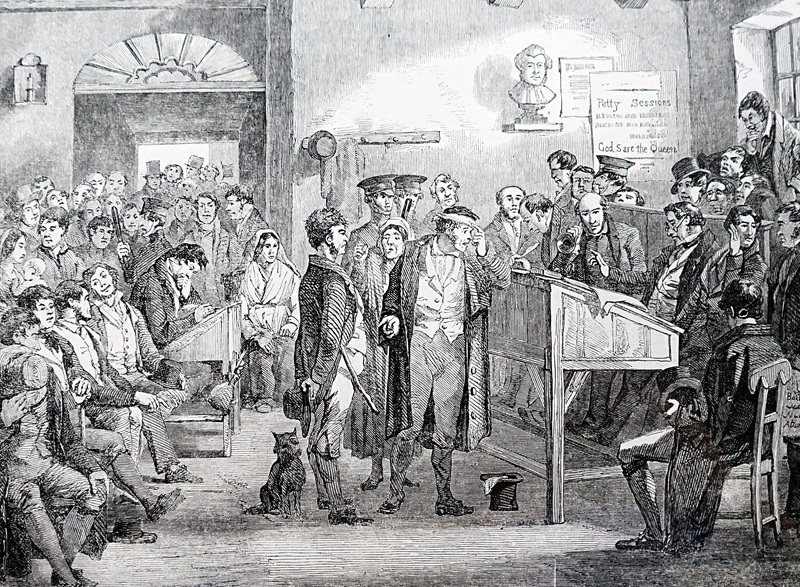
Petty Sessions near Clonmel, dated 19th Century
The courts administration inherited from the pre-independence period was fragmented, inefficient and marked by patronage – judicial and political - in the making of appointments. Administration and staffing lacked any centrally managed structure. The different court jurisdictions operated under separate systems of recruitment, supervision, salary arrangements and conditions of service. The higher court offices were overstaffed and burdened by duplication of administrative activity.
Although the Supreme Court of Judicature (Ireland) Act 1877 had successfully unified the jurisdictions of the superior courts, and had given certain of their officers civil servant status, consolidation of the offices supporting those courts was only partially successful. By 1926, the High Court administration remained divided into numerous specialised offices with no central registry through which litigation could be processed from commencement to conclusion. Instead, separate offices dealt with pleadings, writs, judgments, probate, bankruptcy, wards of court, admiralty, taxation of costs, accounts and other specialised matters.
Litigants frequently had to conduct business with several different offices, and with clerks attached individually to judges or registrars, creating unnecessary complexity and inefficiency. Chief Justice Hugh Kennedy observed in 1926 that a single case often had to pass through multiple offices at different stages, illustrating the cumbersome nature of the inherited administrative system. Lord Glenavy - who had chaired the Judiciary Committee tasked to design the new courts system - pointed to extensive duplication of work and over-staffing in offices. Staff in separate divisions such as Chancery, Bankruptcy and Probate performed substantially similar work, resulting in considerable overlapping of functions.
While the 1877 Act had begun to replace patronage for junior clerkships with recruitment by competitive examination, it preserved the appointment powers of senior judicial office-holders—including the Lord Chancellor, Master of the Rolls, Vice-Chancellor, Presidents of Divisions and Land Judges—in respect of many senior court officerships. The senior Judiciary also retained substantial influence over staffing arrangements, subject to Treasury approval, while the Lord Chancellor participated in determining salary scales for court officers.
This led to appointments based upon personal or family connections rather than merit. The patronage system also contributed to unusually lengthy tenure in office. One notable case was that of Hugh Doyle, Chief Clerk in Bankruptcy, who retired at the age of 90 after 73 years' of “unexampled service”. Having entered the courts as a 17 year-old in 1849, Doyle remained in active service until the occupation of the Four Courts during the Civil War.
Attempts to eliminate these practices before Independence proved unsuccessful.
Growing dissatisfaction culminated in the appointment in 1921 of the Waterfield Committee to investigate the organisation and staffing of the Irish legal departments. Its report was highly critical. The Waterfield report identified an excessive number of patronage appointments, the retention of salaried officers incapable through age of performing useful work, excessive salary levels for relatively minor duties, duplication of functions, the existence of isolated “water-tight” administrative compartments and short working hours. Although the British Treasury accepted the report, political events prevented substantial implementation, and the Free State Government inherited the unreformed system.
Minister for Justice Kevin O’Higgins in 1925 added his own criticism of “over-staffing, extravagance, poor output of work, and wholesale patronage” in the higher courts, while acknowledging the high quality of many officials recruited through competitive examination.
Similar problems affected the lower courts. The clerks of petty sessions were appointed by the justices for the district concerned and held office at the pleasure of the justices and the Lord Lieutenant. Their salary was fixed by the Lord Lieutenant on the justices’ recommendation of those justices, depending on workload. Appointments of Clerks of the Crown and Peace were made by the Lord Lieutenant - a political office-holder. The Registrar of the Civil Bill Court was appointed by the chairman of quarter sessions or in the case of Dublin, Cork and Galway by the Recorders of those cities, subject to the Lord Chancellor’s approval. The Clerks of the Crown and Peace appointed their own staff, also subject to the Lord Chancellor’s approval.
Tenure was somewhat uncertain. The Clerk of the Crown and Peace held office for life, unless they resigned or were removed for misconduct or incapacity by the Lord Chancellor”. The Registrar of the Civil Bill Court held office until death or resignation, or until the chairman who appointed him vacated office, and was removable by the Lord Chancellor at the latter’s discretion.


