This page is part of the Court Officers Act 1926 exhibition.
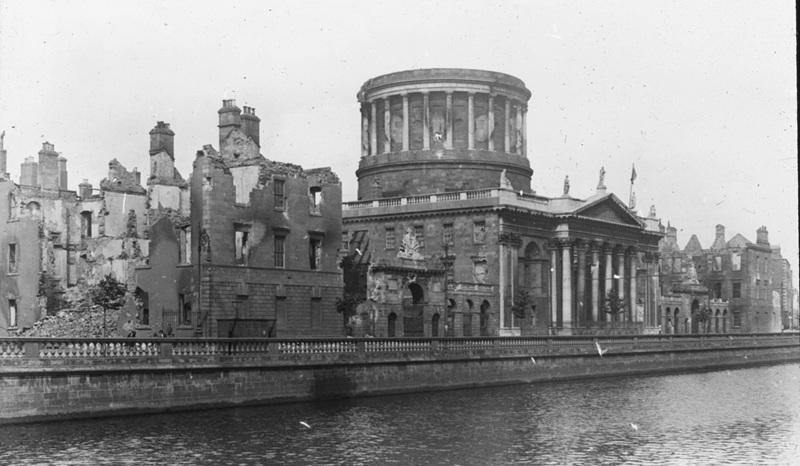
The Four Courts lay in ruins after the battle in June 1922 (Irish Architectural Archive)
Court offices in Dublin and the Provinces operated largely independently, and interchangeability of staff between offices and opportunities for career progression were limited.
The resignation of court officers appointed under the British regime who preferred to take the compensation guaranteed to them under the Anglo-Irish Treaty, rather than serve under the new independent administration, and the discharge of other officers by the incoming Government, involved a loss of vital experience and expertise. Others opted to join the Supreme Court of Northern Ireland on the abolition of the Supreme Court of Judicature in Ireland by the Government of Ireland Act 1920 and the creation of two separate jurisdictions for Southern Ireland and Northern Ireland.
Court budgets were limited by the damage caused to the new State’s public finances by the recent War of Independence and Civil War, the difficult economic situation in the country generally, and reduced public expenditure.
As was the case with much of the country’s public infrastructure, courthouses and petty sessions venues across the country had been badly affected by the War of Independence and subsequent Civil War. Some 88 courthouses nationwide had been damaged or destroyed during the former conflict and by the end of August, 1922, the first two months of the Civil War had seen no less than 13 courthouses destroyed outside Dublin. Most significantly, the Four Courts in Dublin - the main seat of justice - was in ruins at the end of June 1922, having been the base of the Anti-Treaty forces on the launching of the Civil War. Court offices would not be relocated in the Four Courts until the completion of its restoration in 1931.
County Wexford is an example of a county which was particularly badly affected. The old courthouse in Wexford town, built in 1806, was burned down by the IRA on the 18th June 1921. Some three months before, the petty sessions courthouse at Arthurstown had been destroyed. During the Civil War, Enniscorthy courthouse was used as a base in the early part of July 1922 by the anti-Treaty IRA, and abandoned in flames as they withdrew. Gorey Courthouse was also burned down by anti-Treaty forces in early July 1922.
The abolition of the parallel courts system operated during the War of Independence by Dáil Éireann – which was wound up between July and October 1922 – presented a further challenge. Many of the staff of the Dáil Éireann courts had an expectation – encouraged by the Government - of securing administrative posts, especially at District Court level, in the new courts.
Return to the Court Officers Act 1926 exhibition


