This page is part of the Court Officers Act 1926 exhibition.
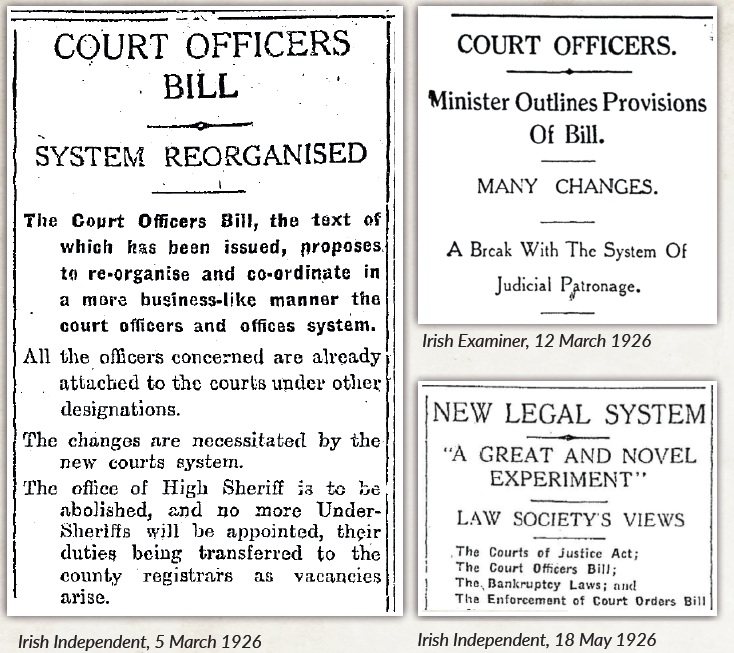
Newspapers of the day covered the Bill extensively
In its report of 1923, the Judiciary Committee made key recommendations in respect of the administration of the new courts system it had proposed.
For the High Court, it recommended that a Central Office, headed by a “Chief Official or Master”, be established where all proceedings would be issued or filed. To address the problem of patronage, it proposed that the staff of the higher courts be civil servants, vacancies at junior level to be filled by competitive examination, and appointments at senior level being made largely from officers promoted from the junior ranks.
It proposed that a new court office be established at county level, under the management of an officer whose functions would combine those previously performed by the Clerk of the Crown and Peace and the Registrar to the County Court and Judge of Assize – the future post of County Registrar.
The Government gave priority to legislating for the new courts in the Courts of Justice Act 1924, and it was not until February 1926 that it introduced a Bill in Dáil Éireann - the Court Officers Bill 1926 – providing for the permanent administrative structures to support those courts.
In the meantime, the office of Clerk of Petty Sessions was replaced by the new office of District Court Clerk, performing the same functions. The Courts of Justice Act 1924 preserved the position of all registrars, clerks and other officers “[u]nless and until otherwise determined by the Oireachtas”.
The 1926 Bill proposed a new office and staffing structure for the different tiers of jurisdiction, as follows:
- in the High Court and Supreme Court, the following offices and senior officerships:
- the Central Office, under the management of the Master of the High Court, who also was to be given quasi-judicial powers
- the Master's Office (subsequently deleted from the Bill as being unnecessary in view of the Master’s management function in respect of the Central Office)
- the Taxing-Master’s Office under the management of the Senior Taxing-Master
- the Probate Office, managed by the Probate Officer;
- the Bankruptcy Office (to include the Registrar’s branch, managed by the Registrar in Bankruptcy and the Assignee’s branch, managed by the Assignee in Bankruptcy)
- the Office of Accounts and Inquiries, managed by the Officer for Accounts and Inquiries (renamed “the Examiner’s Office” and “Examiner”, respectively. by the time of enactment of the Bill)
- the Accountant’s Office, managed by the Accountant of the High Court
- the Office of the Registrar of the Supreme Court (under the management of that Registrar, who was also Registrar to the Court of Criminal Appeal)
- an Office of the Registrar to the Chief Justice (administering the wardship jurisdiction exercised by the Chief Justice in respect of incapacitated adults and minors, and the business formerly transacted in the Chambers of the Lord Chancellor - mainly solicitors’ matters and commissioners for oaths), under the management of the Registrar to the Chief Justice
- interchangeability of staff (other than the principal officers) between the offices of the higher courts as and when directed by the Minister.
- In the Circuit Court,
- a Circuit Court Office for every county and county borough, managed and controlled by a new officer (as recommended by the Judiciary Committee) – the County Registrar - appointed by and holding office at the pleasure of the Government.
- the County Registrar would perform the functions previously exercised by the Clerk of the Crown and Peace and the Registrar of a Civil Bill Court, in addition to any new powers and duties conferred by statute or rule of court.
- in the District Court,
- the office of District Court Clerk, created on an interim basis in 1923, was placed on a permanent footing, and the temporary District Court Clerks appointed under that Act were effectively re-appointed on the conditions of service (some being permanent and pensionable, some being temporary) they had previously enjoyed
- the office of registrar of district court clerks – the successor to the Office of the Registrar of Petty Sessions – was abolished and integrated into the Department of Justice.


